Monday, November 11, 2013

right now // make this place your home.

On this, the day that we are finally getting on that plane to literally change our home and place of residence, we are taking a lot of refuge in the calming, gentle, wonderful sounds of music. And there is a song we'd love to share with you today. 

Ever have those songs that touch you in a way that, to you, they mean whatever you need them to mean? Well this one has been that for us. It's called "Home" by Philip Phillips. Technically, we don't know the meaning of why this song was written or what the words were chosen for. And yes, it was debuted on the (secular) pop music charts. But in just listening to the melody and the lyrics, to us, it feels like it is from the point of view of the Lord, just talking to us. Ever since this song came out (in May 2012, have you!), it has felt like a "chin up, my darling child" sentiment from God, that He is saying,

"we'll get there, we'll get to Honduras, together, and I'll work it all out for you. It will even start to feel like home before I'm done. I'll do everything needed to make it feel that way for you." 

So we'd like to invite you to sit back, read these lyrics, and maybe even listen to this incredible instrumental version (that is enough to make anyone feel loved and provided for by God -- oh, beautiful music.).


"Hold on, to me as we go
As we roll down this unfamiliar road
And although this wave is stringing us along
Just know you're not alone
Cause I'm gonna make this place your home

Settle down, it'll all be clear
Don't pay no mind to the demons
They fill you with fear
The trouble it might drag you down
If you get lost, you can always be found

Just know you're not alone
Cause I'm gonna make this place your home"


We are so thankful for the gift of music that God has given us on this earth, and that it truly is art that can truly be interpreted by the beholder, the one listening and relishing in it. Do you have a "secular" song that means something very spiritual to you? If so, please share it with us in the comment section below!

Thank you all so much for all of your prayers, support, and love that has gotten us to this point. Thank you for believing in God's call for our lives no matter what. We'll let you know as soon as we can that we've made it safe & sound. 


If you'd like to hear the original signing of these lyrics, please click here.  

For other songs that are bringing us comfort & peace today,  here's a few more so you can listen with us:


Friday, October 25, 2013

training // goodbyes & hellos

Saying goodbye to Colorado, then Virginia, and then a "hello" to this beautiful Honduras.
On our last couple of days at our training at MTI, we had all completely bonded more than most all of us had even imagined we would. We knew that we were being asked to live completely in community for a month -- every meal, every time you wanted to use the internet or sit on a couch, every time you went to class, you had to be with everyone. That's a lot of people time. And a lot of other-people's-kids time. We went in afraid that we might not really have an down time or that we might just get too much "people time". And for people like us, you know - extreme extroverts - if we're afraid of too much people time, that really means something.

Well by the end, the extroverts & introverts alike were broken hearted to be leaving. We all had kind of just blended into one giant family; there were times where each of us had been a part of the "village" that it takes to raise each kid, we had eaten plenty of meals with every person there, and together we'd been through plenty of both ups and downs. Even plenty of those moments where everyone has so much fun getting really too into games that you're playing. Sounds just like a family, right?

After this month of making family with people who are all going out all over the world, our training had to come to an end. And, of course, at that end when we have bonded so much, our trainers had us go through probably the hardest topics we'd cover: grief & loss, and goodbyes & hellos. During our day spent on grief & loss, we were asked to go deep and explore those losses we are guaranteed in our new vocation:

1) the loss of a stable home; a place that is familiar to you, that offers warmth and security, a place of refuge. This is the loss of consistency and dependability and balance. 2) the loss of safety; this is the most underestimated loss in missions. In America, one of our core values is safety and comfort -- what happens when you find out that the system is corrupt and justice isn't there. There are so many "what ifs" of what could actually happen to you now. 3) the loss of competence; who are we when we are stripped of our ability to contribute in a new language and a new culture? 4) the loss of identity; how to you grieve when you realize that in many ways you'll never be an insider anywhere & when you realize how much of your identity was set outside Christ before? 5) the loss of support system; we're now entering a vocation that is a revolving door of relationships, and we're being asked to grieve the loss of friendships that must be transitioned out in order to make room for new ones. 6) the loss of quickly and easily attained goals; going and making disciples of the nations is a job that's never done. It's hard to feel like you've made a difference.

We had a two hour period of time where all we did was grieve together; we sat and prayed with and in front of each other and let each other cry. It's honestly what we didn't even realize that we needed... to be able to grieve these kinds of losses of everything we know and hold dear with people who are doing the same thing. "A heart awakened to great love is also opened to great pain."

And if one day full of facing our heartbreak and pouring tears wasn't enough, we had another one the very next day -- our last full day of classes. This time our focus was on saying goodbyes & hellos and opening up to each other about the people, places, even pets, that we are having such a hard time saying goodbye to. Our trainers gave us TONS of advice on how to say our goodbyes well, because healthy goodbyes are part of a gift that we're giving to those we are going to say hello to, so that each person gets as much from us as the last. We have to let people know what residence they have taken up in our hearts, as well as admit that it hurts. But we can't forget about our "I can't wait to go!" attitude, in being firm in what God has called us to.

Our last day was our goodbyes and a time of "praying around the world" -- praying specifically for each missionary that is going out into the field from our training class. And the list is amazing; they are going out to Mexico, South Sudan, Ecuador, Thailand, Honduras (not just us, another couple too!), China, Nigeria, Swaziland, the Middle East, Kenya, Albania, Japan, Czech Republic, Ukraine, Niger, Malaysia, and Central Asia. Our trainers then did our commissioning, and gave us an incredible example of how to say our first "good goodbyes". As in African tradition, one of our senior trainers, who is South African, led everyone in walking each group that left out of the building, following them all the way down the driveway, and waving them goodbye until they couldn't see us any more. (It was so incredibly precious, and obviously made Lesley cry.)

And with that, we had to say one of the hardest goodbyes we've had to do in a while, just because of how unique it was. We had not had a close community of people around us in a long time, since all we've done over the last year is move around and travel. We also had never had to say a goodbye to people dear to us that we may, quite literally, never see again. But it hurts because we loved well. 

Please be praying for us as we are about to say the really, really hard goodbyes -- goodbyes to home and to family. Please be praying that we would do these really well, even when that means relishing it how much it hurts. Next step is Honduras! Next step is a brand new kind of life.

Tuesday, October 22, 2013

training // what we're walking away with, pt. 3

Our MTI training class family :)
In hopes that these posts would not be too long, we've split them up into more achievable lengths. To read about the beginning of our cross-cultural training, please read "what we're walking away with, part 2." 

In reference to thinking about our personal values & beliefs (from our previous post), as Americans, and as Christians, we had to explore when we should embrace a new culture's completely different values, and when we should protest them in our training. Of course, God's Word is absolute -- we must always conform to what the Word asks of us, even if it directly contradicts a culture that we are living in. Because when we obey God, we make a statement that He is trustworthy, loving, and in control; He is not vindictive, unpresent, or mean. Him giving us commands does not take away from His mercy or compassion or knowing of all things. We are just making the statement that He is God and we are not.

But what about the areas that the Bible is unclear on? For this, we explored the ministry of Paul.

1 Corinthians 9:19-23: Paul’s Use of His Freedom

"19 Though I am free and belong to no one, I have made myself a slave to everyone, 
to win as many as possible. 20 To the Jews I became like a Jew, to win the Jews. 
To those under the law I became like one under the law (though I myself am not 
under the law), so as to win those under the law.21 To those not having the law
 I became like one not having the law (though I am not free from God’s law 
but am under Christ’s law), so as to win those not having the law. 22 To the weak
 I became weak, to win the weak. I have become all things to all people so that 
by all possible means I might save some. 23 I do all this for the sake of the gospel,
 that I may share in its blessings."

We learned that Paul was motivated to be spiritually fruitful, morally faithful, and culturally flexible. Conforming and embracing a new culture was permitted in his ministry when Christ-centered principles were not compromised; where he could enhance the unity for people he was sharing the gospel with. But he never violated his allegiance to Christ.

One of the values we are called to have as followers of Christ is to be people who take rest and keep the Sabbath. We spent an extended amount of time on this topic, and  had to ask ourselves this question, "We would never intentionally and maliciously break any of the other commandments, so why do we do it with this one?". We explored our tendency to overwork, especially coming from our culture in the U.S., and it's impact. It seems that even when our sole job is to work in ministry, we are so tempted to break this command that God has given us. God asks us to start our week in celebration and awe of what He has done... to start & work from a place of rest, not rest from a whole week of work. Taking rest & Sabbath is being obedient no matter what is convenient; it is declaring that we are marked and set apart for God. It was really beneficial for us to explore this often glazed over or forgotten concept with our classmates and trainers, especially to try to seek out why we personally act the way we do towards taking rest, and to help us see ways where we can actively place rest into our lives. The day that was devoted to learning this really taught us that everything, every bit of time and moment, doesn't have to be qualified & counted for. Disciplines of rest and play, even of taking time to see God's bigness and "wasting time" has it's own time, place, and function. (Luke 10:38-42, anyone?) BOY, did we need to hear that lesson. (Again.)

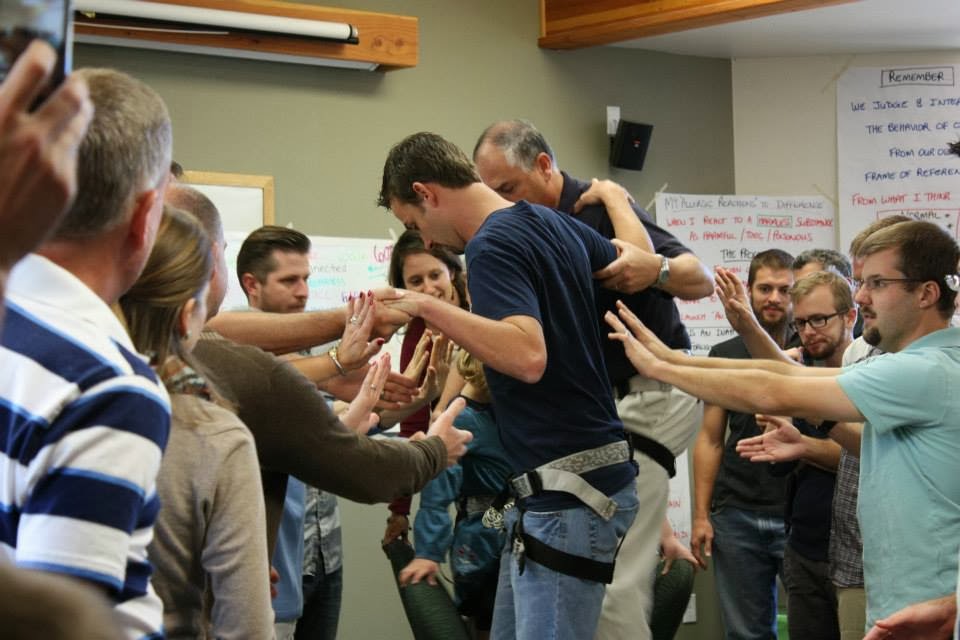
Our "Transition Bridge" exercise.
Another major topic of discussion during our lessons was transition and stress. Remember the crazy looking picture from our extras post? With that exercise, we were learning about the different phases of transition: settled to unsettled to chaos to resettling to new settled; and how our big transitions in life take at least 2 years to complete. Yep, years. And everyone will go through these phases at different times and paces. With transition, of course, comes great stress. Especially that tricky time of complete chaos that feels like you have no "normal", no sense of steadiness. For this, we learned about identifying different kinds of stressors (and how Jesus experienced these same kinds while on Earth), our personal signs & symptoms of stress, and how to make a plan for managing stress BEFORE it happens. Then, to take it to a whole other level of truly learning about ourselves under stress, we then had to undergo an intense high-stress simulation for about two hours. It was amazing what we learned about ourselves when simulating a situation of what you do when the unthinkable happens directly to you.

Amazing what all they can fit into just two weeks, huh? We were so floored by the reality of what is soon to be happening in our lives and all of these multiple facets of our new lives, that we are just so thankful for amazing trainers that have so much experience in both decades of mission work personally and in years of teaching so many other training classes. Without their passion, authenticity, and real, honest, open stories of all of these lessons and principles having to be put to use, we would not have learned half as much as we did. Thank you so much to all of the staff at Mission Training International to being so committed to teaching each and every person that comes to learn from you.

Please stay posted on even more that we learned from our training there. More, you say? Yes, even more.

_________________________________________________________________

If you'd like to read more blogging from our classmates:
- "Embracing Inefficiency", by the Janicek Family
- "Missionary Boot Camp", by Alexis
"Entry Posture", by The Russell Family

Monday, October 21, 2013

training // what we're walking away with, pt. 2


Where can I go from your Spirit?
    Where can I flee from your presence?
If I go up to the heavens, you are there;
    if I make my bed in the depths, you are there.
 If I rise on the wings of the dawn,
    if I settle on the far side of the sea,
 even there your hand will guide me,
    your right hand will hold me fast.
Psalm 139:7-10


Since the very first day of our cross-cultural training portion of our time at MTI, we have been eager to share about it all with you, our blog readers & ministry team. But when you are learning things that make you understand even more of how just so very complicatedly human you are, it's so hard to explain it all. All of the topics we learned about hit us to our very core, and it was just a taste of what life-changing and challenging things we know we'll be experiencing by working in cross-cultural ministry.

As one of our classmates excellently put it, it all felt a whole lot like "missionary boot camp". All topics were things that are incredibly hard to even talk about with someone we know really well, let alone with people you'd only known for two weeks. But, the one factor we had working in our favor is that we are all in a common place and can absolutely relate to one another. This helped us to just grow even closer as we explored these so-hard-I-don't-even-really-want-to-go-there-right-now places. One of the greatest things we are walking away with is that we now have a vocabulary to explain a lot of these hard places, feelings, struggles, and reactions.... and people who we can reach out to that are always going to be right there with it us.

Please forgive us if the way that we explain it all doesn't quite make sense yet. :)

To start us into getting down to the nitty-gritty really fast, the first item on the agenda was to discuss conflict. This began by doing an assessment about ourselves completed by us, by people that are close friends & family, and by exploring our last conflict we'd had with someone. Talk about intense homework!! ... calling a person close to you and asking "how well do I handle conflict, how does it make you feel, and what I could I do better?". With this, we learned a TON about different conflict handling styles; how we perceive others' styles and what we can appreciate about & what we might need to confront about them. We also learned that we can most often be misunderstood in conflict when we overuse our dominant style of handling conflict. This section was so helpful in us understanding and being able to pinpoint why we react the way we do in so many different situations, and was really helpful to us even in just understanding each other even better!

We also went through several different sections on adjustment and culture shock. We had to explore ourselves -- what our personal values & beliefs are, and how they influence the filters through which we view things -- and come to an understanding that literally everything we see as "normal, natural, right, and good" could be challenged in the new culture that we are moving to. But that doesn't mean that different values and beliefs from our own are automatically wrong; most everyone across the world acts from a place that is normal & good from their own frame of reference. We do have to be prepared that many countries, including Honduras, have different focuses on everything from the degree of directness that is appropriate, on productivity, the importance of time, on change & tradition, on privacy, equality vs. hierarchy, relationships vs. tasks, etc. We have to be ready to step into each one of these different ways of operation and see the value in them, even if to us they do not seem "natural" or even logical.

We learned that when we will be living and working across cultures, we'll be frequently finding that our personal values will be in conflict with the values and expectations of the people of the culture we're in. Our values could be affirmed, but they could also be challenged; and it will be up to us whether we feel it is most appropriate to change to their comfort zone, or retain our own value either modified or as is.

What do I mean by personal values? I mean how much value we put into things like independence, education, intimate friendships, routine, law & order, safety, effective use of time, schedules, equality, freedom, justice, cleanliness, self-reliance, respect, even adequate resources. What our personal values are and how much weight we put into them will effect the lifestyle choices that we will make on the field. And the reality is that we can't please everyone... "try to please all and you will end up pleasing none." We must first consider God, our spouse/family, and the people we're working with when making our lifestyle choices. And we learned through this training that the most important thing to do when making decisions is to consider our longevity -- it was very clearly explained to us that if we do not live in such a way that we can take care of ourselves long term, we will end up burn out and will have a high, high risk of coming back prematurely.

But often every choice we have to make feels so much harder to make as missionaries, since we have so many more stakeholders that we have to consider. All of a sudden new people (like our supporters, sending organization, nationals of our new host country, sending church, other co-laborers,etc.) that are all effected by or have weight in the decisions that we have to make. And some decisions and lifestyle choices for us will occur daily on the field; things like food, clothing, scheduling, housing, and even what our male/female family roles will look like, are all decisions that are under a microscope for us while working in a new cultural that is unlike our own. We have to live in such a way that balances us taking care of ourselves for the purpose of longevity, and living in a context to where we are not a distraction of the Gospel. 


In hopes that these posts would not be too long, we've split them up into more achievable lengths. To read about the rest of our cross-cultural training, please read "what we're walking away with, part 3".